
Life comes first. Formats come later.
Before there is a task, a note, an event or a contact, there is something happening in a person's life. A colleague asks for a decision. A parent needs a call. A doctor gives a date. An idea arrives while a song is playing. The format is secondary. The meaning is what came first.
Most productivity tools reverse that order. They ask us to decide where an experience belongs before we have had time to understand it. Is this work or personal? Is this a task or a note? Is this person a contact, a customer or a member of a project? Which workspace owns the meeting? Which list owns the promise? The tool demands classification at the exact moment when our attention should remain on the thing itself.
Over time, those choices become a hidden form of labor. We maintain a map of applications, accounts, folders and conventions so that we can later find the pieces of our own day. The map may be tidy, but the life underneath it is still connected in ways the folders cannot express.
Jikoku begins from the opposite assumption. Human context exists before information architecture. A meeting can involve a person, create a task, change a project and alter the shape of tomorrow. Those are not separate records that happen to share a date. They are different views of one situation.
Work and life do not take turns. They share the same hours.
The false border between work and life.
The phrase work-life balance often imagines two clean territories. In one, there are meetings, deadlines and presentations. In the other, there are appointments, relationships, health, rest and private ambitions. A person is expected to keep the two apart, then balance them from outside.
Real days are not arranged that way. The dentist appointment changes which meeting you can attend. The promise to a friend occupies the same evening as a deadline. A work conversation gives you an idea for a personal project. Learning a difficult guitar part may matter more to your sense of progress than finishing one more administrative task.
None of this makes personal life another job. It means that time is shared. Attention is shared. Memory is shared. The same person carries every commitment, even when software insists on giving each one a different account and color.
Jikoku does not ask you to merge every part of life into an undifferentiated list. Differences matter. A meeting is not a task. A person is not a project. A thought is not an appointment. The purpose is not to make them identical. It is to let them remain different while still being visible to one another.

Productivity without administration.
A personal tool should not require an organization chart. It should not need an owner, an admin, a workspace, a permission model and a vocabulary lesson before it becomes useful. Those structures have a place in large organizations. They should not become the default shape of an individual mind.
The modern productivity stack often asks people to operate a small internal company. We create systems for intake, review, prioritization and archival. We decide how every object should be tagged. We redesign the system when our work changes. We watch tutorials about maintaining the tool that was supposed to reduce maintenance.
This can feel productive because the system itself is visible. Moving objects, designing views and refining labels all create a sense of order. But the appearance of control is not the same as understanding. A perfectly maintained workspace can still keep the important conversation far away from the task it created.
Jikoku aims for a quieter relationship. It uses the Calendar, Reminders, Notes and Contacts already present on the Mac. The application adds a shared view and local intelligence, but it does not begin by asking you to migrate your life into a new content universe.
The ideal is not an app you admire all day. It is an app that helps you see the next honest shape of your time, then gets out of the way.
Technology should become less visible.
Good tools have a strange kind of modesty. They are precise when needed and nearly absent when not. A calendar should reveal the weight of a day without making the calendar itself the subject of the day. A reminder should keep a promise close without turning every promise into a productivity metric.
This is why Jikoku is built as a native Mac application. Native is not only a visual preference. It is a relationship with the machine. Keyboard behavior, drag and drop, system permissions, local models and Apple data frameworks belong to the environment instead of being simulated inside a browser tab.
The Mac already knows when your meetings happen. Reminders already holds many of your intentions. Notes already contains fragments that later become decisions. Contacts already remembers the people around the work. The opportunity is not to replace those foundations. It is to help them make sense together.
When the technology is calm, it asks fewer ceremonial questions. It does not force a new method before it can show value. It does not make organization the entrance fee for clarity.
The best system is not the one you maintain most carefully. It is the one that returns your attention.
Intelligence without extraction.
Artificial intelligence can be useful in the most personal parts of work. It can turn speech into a structured reminder, shorten a long meeting, identify a possible commitment inside a note and help a person search language instead of filenames. These functions become valuable precisely because they touch context.
That same intimacy makes the architecture matter. A transcript is not generic text. It may contain unfinished decisions, private concerns, names, disagreements and plans that were never meant to become training material or an advertising signal. A calendar is not merely a sequence of timestamps. It is a map of relationships, health, movement and attention.
Jikoku's language and transcription models are bundled with the app and run on the Mac from the start. Notes and transcripts do not need to travel to a Jikoku server for processing, because no such content service sits behind the product. The point is not to make a theatrical claim that nothing external ever exists. Apple remains involved when iCloud synchronizes system data, and configured calendar providers remain responsible for their own accounts. The point is to avoid adding another company to the center of the path.
Local AI also changes the economic relationship. A private thought does not need to become a metered request. A summary does not have to justify the cost of a round trip to a provider. The machine on the desk can perform work for the person who owns it.

Bento is not a layout trend.
A bento box holds different foods in one place without pretending they are the same thing. Each part keeps its texture, temperature and purpose. The arrangement creates a whole, but the whole depends on the boundaries remaining meaningful.
That is a useful metaphor for a day. Work, care, health, friendship, learning and rest should not be blended into one gray substance called productivity. They deserve their own character. Yet they also need to fit inside the same finite container of time and attention.
Jikoku's idea of bento is therefore not a grid of fashionable cards. It is a principle of proximity. Place the task near the hour it requires. Keep the meeting near the notes it produced. Remember the person near the commitment that involves them. Let a private ambition sit beside professional responsibility without forcing either one to change its name.
Good arrangement makes difference legible. It helps a person notice when the box is too full, when one part has crowded out all the others, or when something important has been left outside because no application knew where to put it.
A personal computer should feel personal.
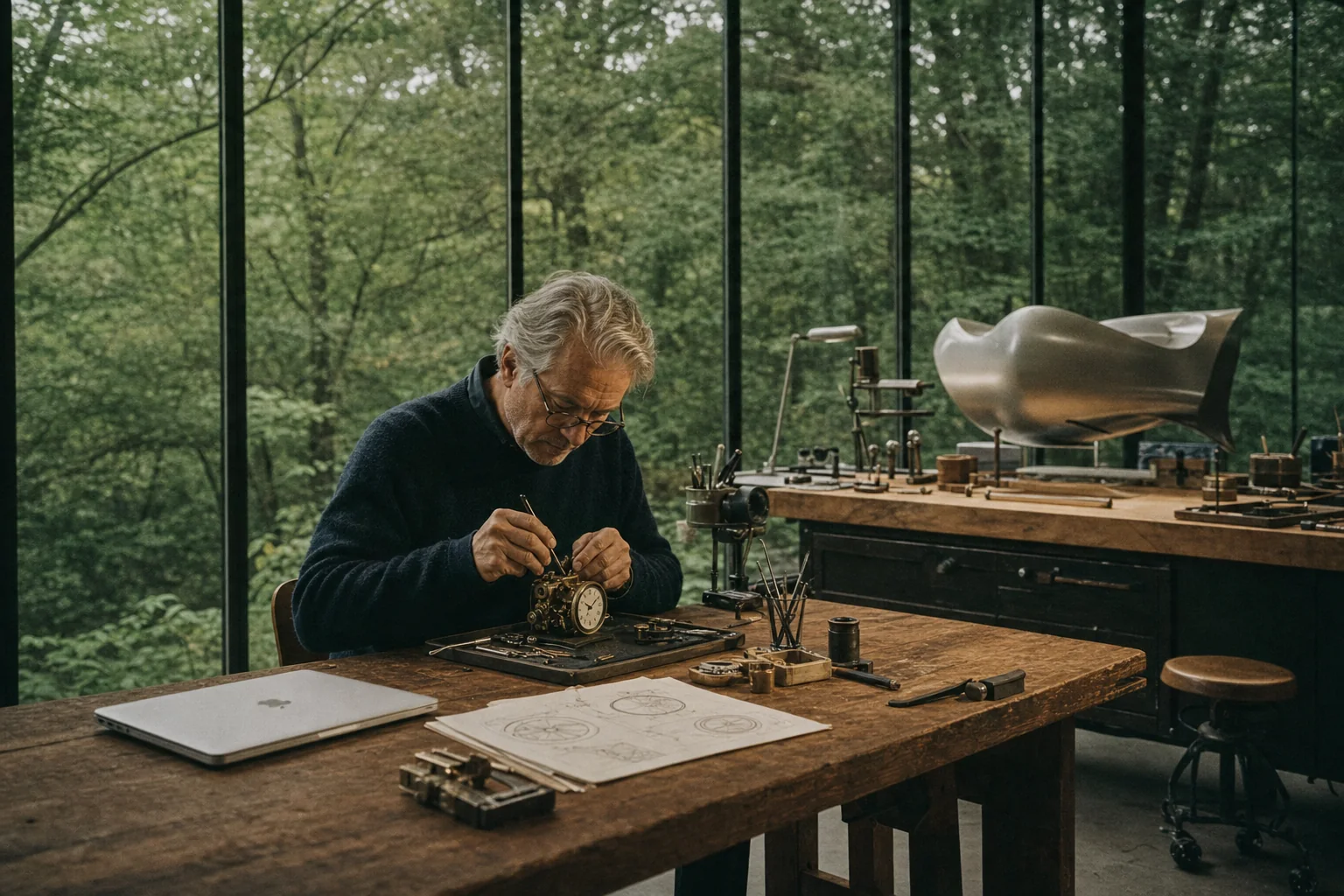
The personal computer was once a clear promise. It was a machine close to the individual, shaped by their files, their tools and their way of thinking. Cloud software brought enormous convenience, but it also moved many ordinary acts of thought into rented spaces governed by accounts, tiers and changing terms.
Jikoku is a small argument for the Mac as a place where serious work can happen locally again. The device has fast processors, private storage, system applications and a mature interface culture. It should not be treated only as a thin window into someone else's infrastructure.
This does not mean isolation. iCloud remains useful. Calendar providers remain useful. The network remains useful. The distinction is architectural: connection should serve the person, not make the person dependent on a new intermediary for every act of understanding.
Your time is intimate. Your notes are unfinished. Your contacts are relationships, not records. Your intentions should be allowed to stay close to the computer you chose to trust.
The measure of calm.
Jikoku will be successful if it reduces the number of times a person must stop and ask where something belongs. It will be successful if a commitment found inside a conversation can become visible before it is forgotten. It will be successful if planning a difficult day feels more like understanding and less like data entry.
The ambition is not to make every hour efficient. Some hours should be open. Some ideas should remain unstructured. Some personal goals should exist without being optimized. A humane tool respects the difference between remembering an intention and turning a life into a performance dashboard.
Calm technology does not shout about how much it can do. It gives context at the moment context matters. It protects the quiet material of a person's day. It remains close enough to help and modest enough to disappear.
That is the direction behind Jikoku: one place for the work and life that make you who you are, built around your Mac, your data and your actual time.